
Halbert Unit Release Paths
Ellen Halbert Unit is a TDCJ correctional treatment facility at 800 Ellen Halbert Drive in Burnet. Its custody path is statewide. The unit's physical location in Burnet County does not make the sheriff the custodian of its prison records. TDCJ governs admission, classification, movement, release review, and state discharge records, even when the conviction came from a court outside Burnet.
A departure can be an internal transfer, parole, mandatory supervision, or full discharge. Parole is a discretionary supervised release decided through the Texas Board of Pardons and Paroles. Mandatory supervision is another supervised form controlled by Texas law and eligibility rules. Full discharge means the sentence and supervision obligation have ended. An internal transfer means the person remains incarcerated by TDCJ at a different unit.
- Projected release date
- An estimate in the current record that can change.
- Scheduled release
- A planned event with a date, type, and location when TDCJ displays those fields.
- Parole
- Conditional release to serve the balance under TDCJ Parole Division supervision.
- Discharge
- Completion of the sentence and any associated supervision term.
Search Current Halbert Custody
The TDCJ Online Inmate Search accepts last name, first name, TDCJ number, SID number, gender, and race. A TDCJ or SID number gives the cleanest match. For a name search, TDCJ allows the last name and at least a first initial, but last-name matching is exact. Check punctuation, spaces, aliases, and changed surnames before concluding there is no record.
- Enter the TDCJ or SID number when known, or search the exact last name with a first initial.
- Match the person with identifiers and offense history, not name alone.
- Confirm that the current facility is Ellen Halbert Unit.
- Read the Projected Release Date, Parole Eligibility Date, and any scheduled-release block separately.
- Save the TDCJ and SID numbers for post-release inquiries.
Current detail can show the person's numbers, name, age, facility, maximum sentence date, Projected Release Date, Parole Eligibility Date, parole-review information, and offense history. When processing has advanced, a special block may show Scheduled Release Date, Scheduled Release Type, and Scheduled Release Location. A projection is not a promise. Eligibility is not approval. Even a scheduled field remains subject to review and change.
Why Halbert Results Disappear
TDCJ expressly limits its public search to people currently incarcerated in a TDCJ facility. Once a person leaves state prison, the record generally drops from this search. It does not change to a durable “Released” or “Discharged” result. A no-hit may therefore reflect release, but it can also mean a transfer outside TDCJ, a name mismatch, a timing issue, or that the person never entered the state prison system.
Updates occur on working days, and TDCJ says the information is at least 24 hours old. Treat the search as a current-location tool. For historical confirmation, combine the TDCJ record response with IVSS notice history, Parole Division information, a Board decision when applicable, and the sentencing court's judgment. A county-jail booking record cannot substitute for the later state release event.
Absence from the TDCJ search does not prove release from all custody. Confirm the event type and date with the state agency that controlled the sentence.
Halbert Release Review Process
TDCJ Review and Release Processing checks the legal and practical conditions before a person leaves. Review can include the approved residence plan, county-of-residence requirements, disciplinary matters, special needs, release category, required programs, special conditions, and other case factors. Records staff audit the time calculation and prepare the release certificate. This work explains why a favorable parole vote can precede physical release.
The official review and release page shows the state process used for TDCJ departures.
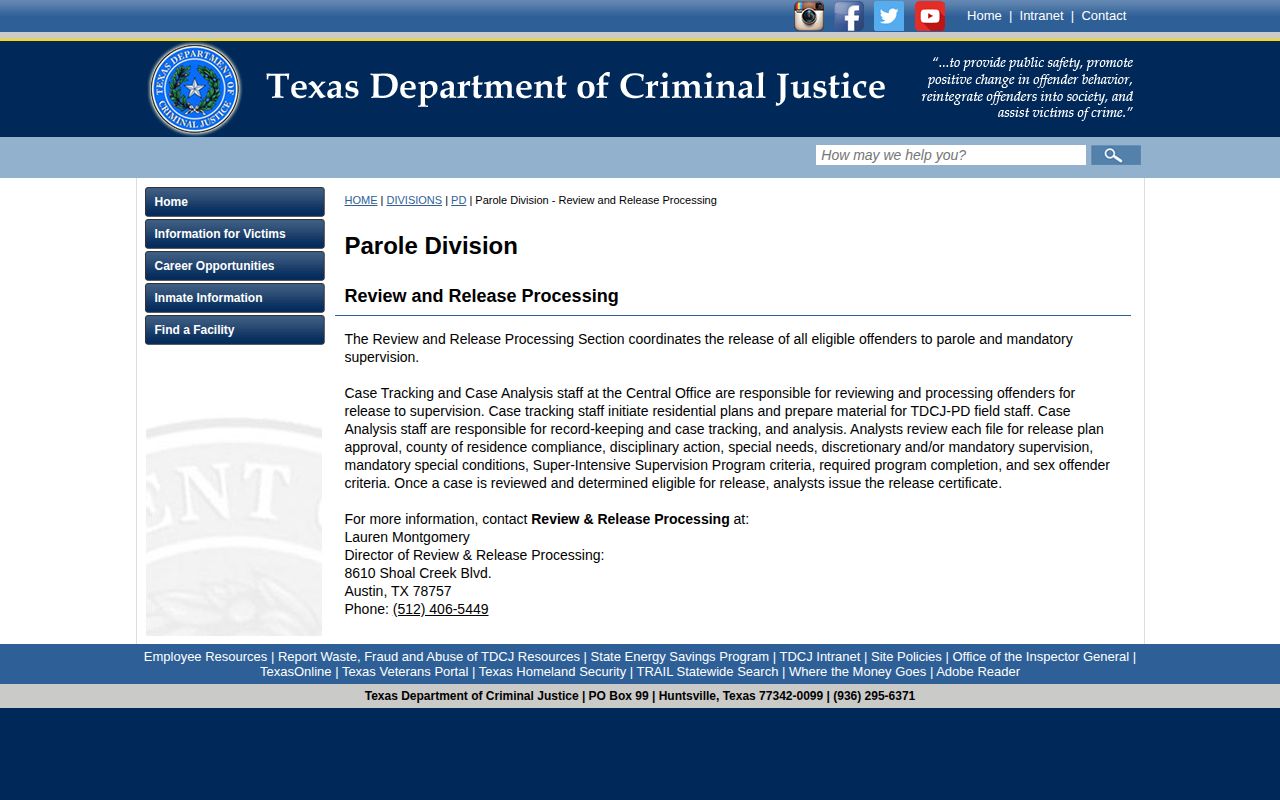
The captured page supports the state release route. It does not show an individual result, so use the person's TDCJ identifiers when seeking case-specific confirmation.
Ellen Halbert Unit Profile
The official TDCJ unit directory identifies Halbert as a state facility and provides its unit-specific information.
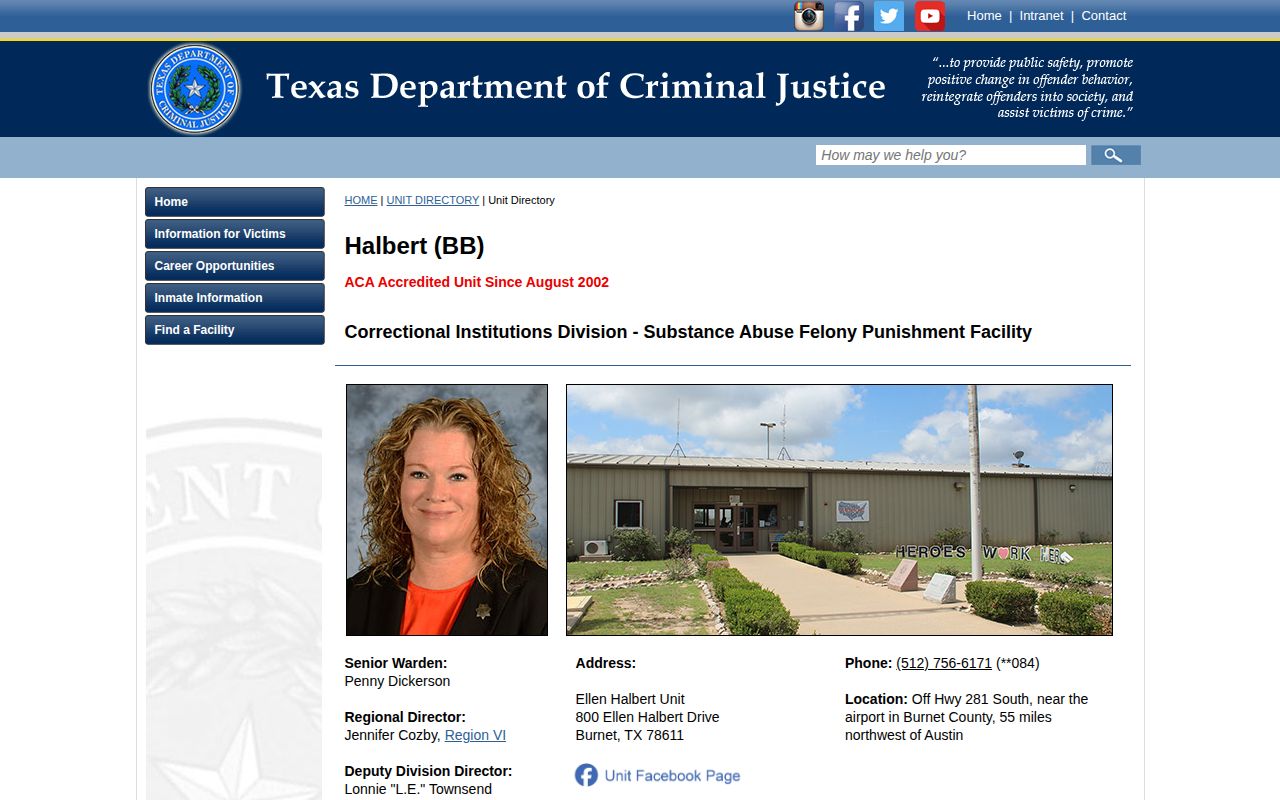
The directory confirms which agency operates the facility. Use its current contact and visitation details for unit matters, while release histories remain a TDCJ records and Parole Division issue.
Halbert is not the Burnet County Jail. People held at the county jail may await court, serve local terms, or wait for transfer. People at Halbert are in TDCJ custody under a state sentence and treatment assignment. This distinction decides which locator, records office, notification system, and release terms apply.
Verify a Halbert Departure
Build a chronology rather than relying on one screen. Preserve the admission date, TDCJ and SID numbers, parole review or court dates, projected and scheduled fields, actual release or transfer date, release type, and any supervision start. If the person went to another TDCJ unit, the current locator may reveal that movement after its update. If the person left prison, request the state record that identifies the event.
| Source | Best use | Limit |
|---|---|---|
| TDCJ current inmate search | Current unit and prospective dates | Excludes released people |
| TDCJ IVSS | Release, discharge, and parole-event notices | An alert is not a certified record |
| Board and Parole Division | Vote status and supervised-release verification | Approval may precede release |
| Sentencing court | Judgment and sentence authority | Not the prison gate timestamp |
The Burnet County released inmates home page compares state, county, federal, and immigration routes. Use it when the last known custodian is unclear. Do not route a Halbert departure request to the Sheriff's Records Division merely because both facilities share the same city.
Halbert Parole and Discharge
Before release, Parole Review Information may appear in the current TDCJ detail. The Board's result line at 844-512-0461 accepts the name, TDCJ-CID number, and/or date of birth. A favorable FI code does not always mean immediate release. Some codes set a future date or require completion of a named program. Read the current vote language and confirm actual departure with TDCJ.
After parole or mandatory-supervision release, Burnet County assignments are associated with the Georgetown District Parole Office in Region IV at 40121 Industrial Park Circle, Georgetown, Texas 78626, phone 512-863-0756. That office is a supervision contact, not a public person-search database. Probation is different. It is imposed by a court and handled through the sentencing court or community supervision department. See Post-Release Supervision for that distinction.
Halbert IVSS Notifications
TDCJ operates the Integrated Victim Services System for state prison and parole events. Registered users can receive available notices about parole eligibility, Board decisions, bench-warrant movement, upcoming release, discharge dates, and other changes. Current methods can include email, text, letter, and some phone notifications. Keep account details and preferences current.
A notification is an alert, not the final release certificate. Match it to the correct TDCJ or SID number and then confirm the recorded event. Texas IVSS-Counties is the separate successor to legacy county VINE for county custody and court notices. It should not be confused with TDCJ IVSS, which is the correct service for an Ellen Halbert Unit prisoner.
Halbert Records and Contact
Ellen Halbert Unit is located at 800 Ellen Halbert Drive, Burnet, Texas 78611. Use the live TDCJ directory for current unit phone, mailing, visitation, and operational information. For release history, use TDCJ offender-information and public-information channels. Parole supervision and releasee-location questions can be directed through the Parole Division, while open-records requests follow the agency's records route.
State custody route
Ellen Halbert Unit
800 Ellen Halbert Drive
Burnet, TX 78611
Use Release Date Lookup to interpret maximum sentence, parole eligibility, projected release, and scheduled-release fields. Keep those prospective dates distinct from the state record of actual release.