
Burnet County VINE Has Changed
The familiar VINE and VINELink names describe Texas's former county notification service. The Texas Office of the Attorney General notification page says county notification moved to Texas IVSS-Counties on September 1, 2025. Existing registrations were migrated. Users were told to update portal passwords and preferences, while text and phone notices continued through a new provider. A current search should therefore enter through the OAG route and follow the live IVSS-Counties prompts.
TDCJ runs a separate Integrated Victim Services System for state-prison and parole events. Burnet County Jail custody belongs on the county side. A person at Ellen Halbert Unit or another TDCJ unit belongs on the state side. The research did not independently confirm Burnet's live county feed inside the new portal, so availability must be checked in the current interface or with the Burnet County Sheriff's Office. No result is not proof of release.
The official OAG transition page shows why a 2026 Burnet County VINE check must use current instructions.
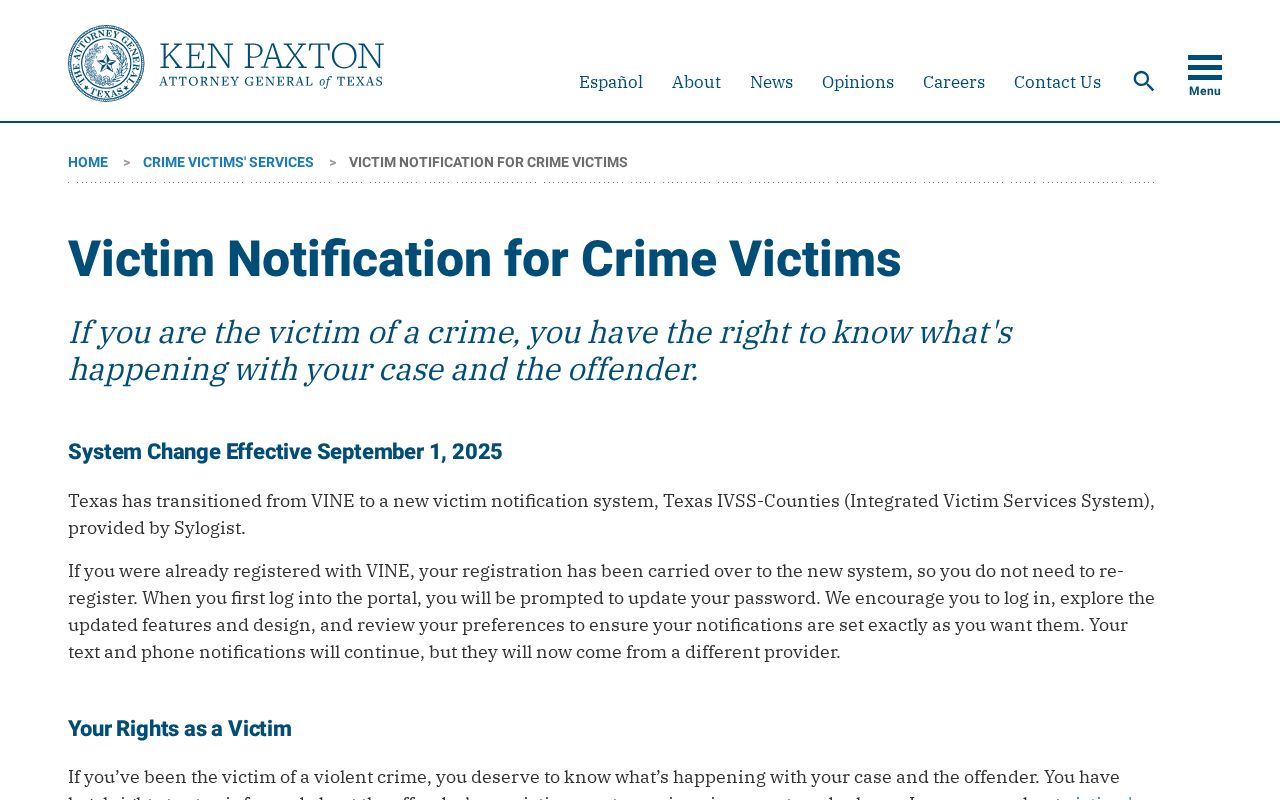
The captured page documents the system change and should be used as the entry point, not as an individual release record.
Search One Burnet County Person
Start with the last known custodian. This prevents a county-jail name from being searched only in TDCJ, or a state prisoner from being treated as a Burnet jail booking. Preserve the booking number, TDCJ number, or SID number whenever it is available. An identifier is safer than a name alone when people share names or use different spellings.
- For a county case, enter Texas IVSS-Counties through the OAG page. Select the county, case, or custody category offered by the live portal.
- For state imprisonment, sign in to TDCJ IVSS and search its limited offender information.
- Enter the person's identifying details. Compare identifiers and custody context before opening a match.
- Read the event label exactly. Release, TDCJ transfer, death, escape, and another custody change are not the same event.
- If Burnet is absent or the person cannot be matched, use the sheriff's release record or the correct state records channel.
A broader search path for a person who has already left local custody appears on the Burnet County released inmates search. IVSS is best used for one known person and selected notices, not as a complete historical list.
Burnet County Alert Fields
The two Texas systems cover different event streams. County notices can include booking, release, court changes, transfer to TDCJ, death, or escape. TDCJ IVSS may cover parole eligibility, a Board decision, bench-warrant movement, an upcoming release, discharge, and other state status changes. Exact fields depend on the live record and access level.
| Field or event | What it means |
|---|---|
| Person or offender identifier | Helps separate the intended booking or TDCJ record from a namesake. |
| Custody category | Shows whether the notice concerns county custody, a court event, or TDCJ. |
| Release | Signals that the reporting custodian recorded an exit, subject to records confirmation. |
| Transfer | Means custody changed hands and does not by itself mean return to the community. |
| Parole or discharge event | Describes a TDCJ event; parole keeps supervision while discharge ends the sentence. |
| Notice history | Can support a chronology after a live custody locator stops returning the person. |
Notification data can lag. The safest evidence is a matching agency record. For Burnet County Jail, ask the Sheriff's Records Division for the release or transfer sheet. For TDCJ, use state records, Parole Division information, or the release certificate history.
Register Burnet County Release Alerts
Registration begins only after the correct person and custody system are selected. Official sources describe text, phone, and email delivery for county events. TDCJ materials also describe letter or personal phone options in some settings. The choices shown in the current account control.
- Create or sign into the account required by Texas IVSS-Counties or TDCJ IVSS.
- Match the specific person with the strongest identifier available.
- Select the custody, court, parole, release, discharge, or transfer events offered for that record.
- Choose the available delivery methods and complete the portal's current confirmation prompts.
- Keep contact details and preferences current. TDCJ permits preference changes and blackout dates for non-emergency notices.
- When an alert arrives, confirm the event with the sheriff, TDCJ, Parole Division, or court record.
The TDCJ notification request page describes the state registration route.
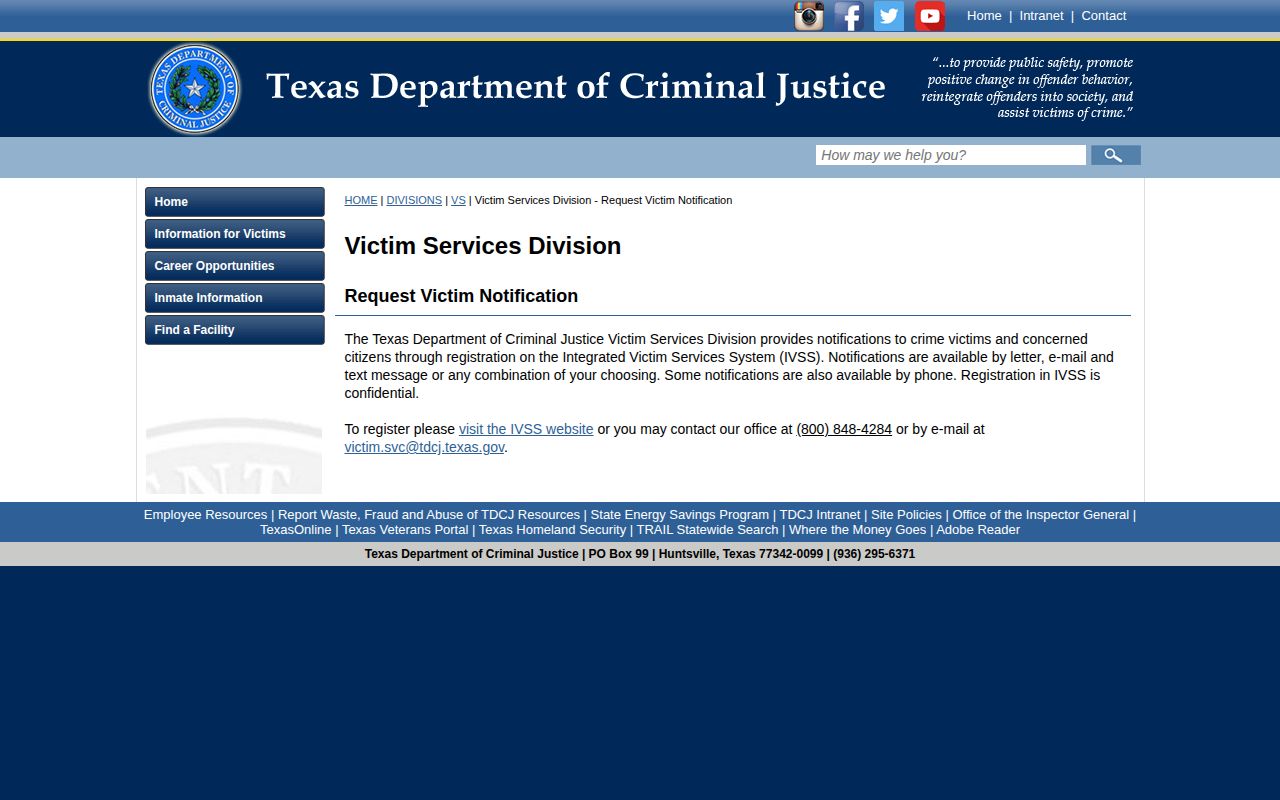
This state page is relevant to a TDCJ offender, not a county-jail-only booking.
Confirm Burnet County Release Alerts
An IVSS message is an alert, not a certified release record. Data entry and delivery can lag. A no-result may reflect a wrong jurisdiction, spelling mismatch, unavailable Burnet feed, or restricted record. County IVSS also is not the BOP historical locator. A person held at Burnet County Jail for ICE or the U.S. Marshals may leave the jail through a transfer that county notification does not fully explain.
The TDCJ current inmate search has another limit. It includes people currently incarcerated in a TDCJ facility and is updated on working days with information at least 24 hours old. A released person normally drops from that search. Preserve the TDCJ or SID number before release, then use IVSS history, Board status, Parole Division, state records, and the sentencing court.
Burnet VINE PIN Is Historical
Legacy Texas VINE phone registration asked a user to create a four-digit PIN. Automated calls continued until that PIN confirmed receipt or the retry period ended. That instruction is now historical. No current authoritative IVSS source says a new 2026 account must use the old VINE PIN workflow.
Follow the password, contact, and verification prompts shown by the live IVSS service. Migrated users may need to update a password and review preferences. Do not wait for a PIN screen that may no longer exist. If the portal itself presents a current confirmation method, that live instruction controls.
TDCJ IVSS displays the current state login and search environment.
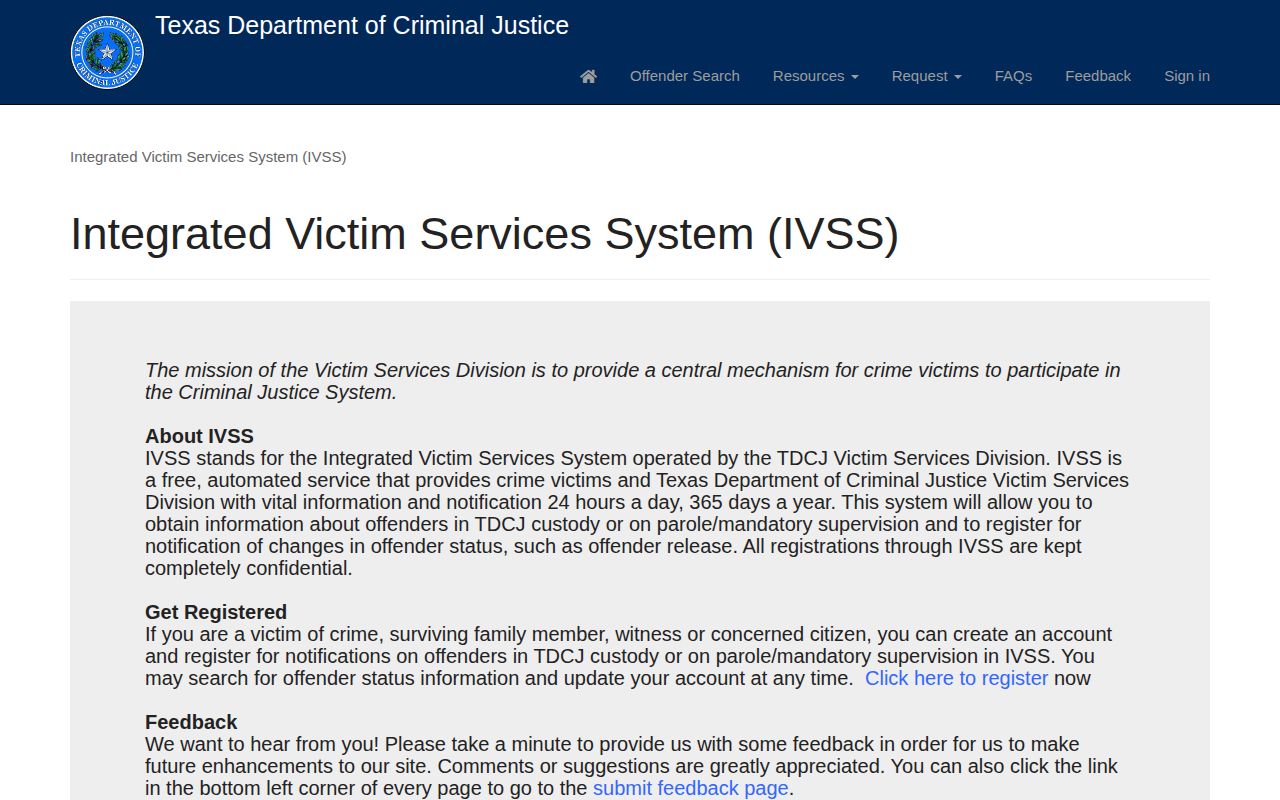
The interface confirms that current account access replaces a generic legacy VINELink tutorial.
Burnet Release Alerts by Custody
A county notification can mark an exit from Burnet County Jail without showing the whole path afterward. The jail also holds some ICE detainees for more than 72 hours and some U.S. Marshals prisoners. It can transfer a person to TDCJ, ICE, USMS or BOP, another county, or another authority. The alert's wording and the sheriff's transfer destination should be read together before describing the event as a community release.
State notification follows a different chain. A TDCJ prisoner can receive a Board decision, become eligible for review, obtain a scheduled release, leave on parole or mandatory supervision, discharge the sentence, or move between units. Parole means supervised release after state imprisonment. Mandatory supervision is another statutory supervised-release form. Discharge means the sentence and supervision have ended. An internal transfer is none of those.
Federal history also requires another tool. The BOP locator can return released federal records, generally for releases after 1982, while county and TDCJ IVSS do not serve as that archive. ICE's locator focuses on current immigration detention. USMS has no comparable public historical locator. For a Burnet federal hold, retain the sheriff record and follow the federal docket or records process.
Resolve Burnet Alert No-Results
A failed match should trigger a careful check, not a conclusion. Confirm the spelling, date of birth, booking number, TDCJ number, SID number, and last known facility. Search only the system that owned that stage of custody. A Burnet jail booking will not become a TDCJ record unless a transfer occurred, and Ellen Halbert Unit confinement is not a county jail stay merely because the unit is in Burnet.
Then build a short chronology. Record the admission date, court or bond event, notice time, any scheduled date, actual departure, and receiving-agency admission. These events can occur on different days. If the alert and official record conflict, preserve both check dates and ask the reporting agency to reconcile them. The agency-produced release or transfer sheet controls over a transient portal no-result.
Keep notification preferences narrow enough to understand each message. County court notices, county custody events, TDCJ parole events, and TDCJ discharge events answer different questions. When an alert uses an unfamiliar term, copy the exact label and ask the responsible office what it means for that record. Do not translate a custody change into release without the destination. A dated agency response, booking number, and offender identifier form a much stronger chain than a name-only screenshot.